

As students progress through their academic journey, the syllabus they encounter becomes increasingly significant. For Class 10 students in the Central Board of Secondary Education (CBSE) system in India, the Hindi syllabus holds a prominent place. Hindi is not just a subject; it's a language that connects us to our culture and heritage. In this article, we will delve into the CBSE Class 10 Hindi syllabus, exploring its components and offering some valuable tips for success.
Understanding the CBSE Class 10 Hindi Syllabus:
The CBSE Class 10 Hindi syllabus is divided into two parts:
1. Hindi A:
- Section A: Reading Comprehension and Writing Skills
- Section B: Literature Textbook and Extended Reading Text
- Section C: Grammar
2. Hindi B:
- Section A: Reading Skills, Grammar, and Writing Skills
- Section B: Literature Textbook and Supplementary Reading Text
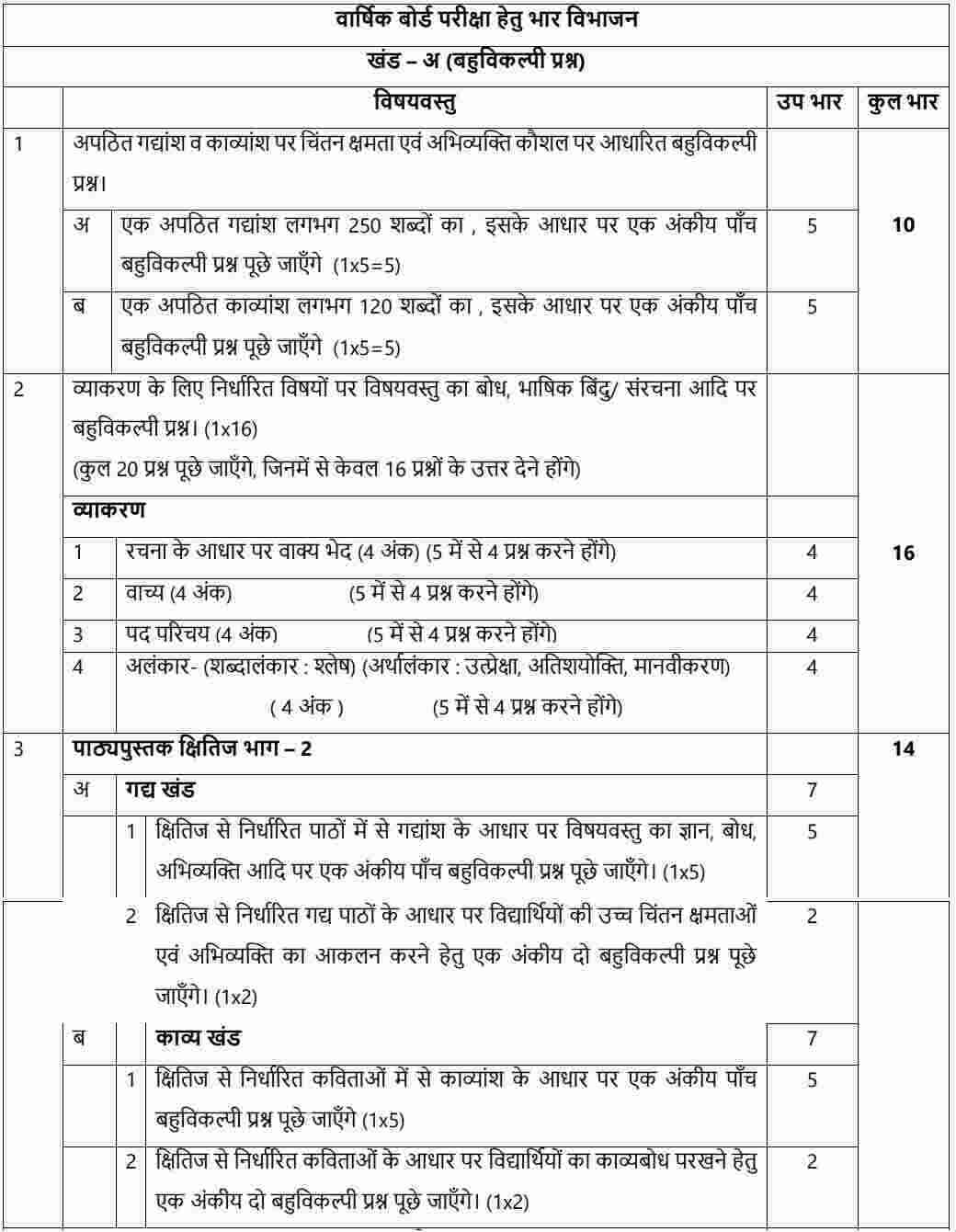
EXAM PATTERN, SECTION-WISE WEIGHTAGE

CBSE Class 10 Hindi A Syllabus 2023-24
Section A
In this part, there will be a total of 44 multiple-choice questions, and students are expected to answer a minimum of 40 questions.
Contents prescribed for Section A are as follows:
Section B
This portion will consist of descriptive questions, and responses must adhere to the specified word limit for each question. Most questions will offer internal choices.
The contents specified for Section B are as follows:

Criteria for Internal Assessment

Key Components:
1. Reading Comprehension and Writing Skills:
- This section tests a student's ability to understand and analyze written texts in Hindi. It also assesses their writing skills, including creative and descriptive writing.
2. Literature Textbook:
- This section explores various chapters from the prescribed Hindi literature textbook. It includes poems, stories, and essays that students need to study and understand.
3. Grammar:
- A strong foundation in grammar is crucial for effective communication in any language. In this section, students are expected to have a grasp of Hindi grammar rules and apply them correctly.
4. Extended and Supplementary Reading Texts:
- These sections encourage students to read beyond their textbooks. It helps improve their vocabulary, comprehension, and overall language skills.
Tips for Success:
- Read Regularly: Reading is the foundation of language learning. Make it a habit to read Hindi newspapers, books, and magazines regularly to improve your vocabulary and comprehension.
- Practice Writing: Regularly practice writing essays, letters, and stories in Hindi. Pay attention to grammar and sentence structure.
- Understand the Literature: While studying the literature textbook, make sure to understand the themes, characters, and messages conveyed in each chapter. Discuss them with your teachers and peers.
- Memorize Important Poems: Memorize key poems from the syllabus. This not only helps in exams but also enhances your ability to appreciate and recite Hindi poetry.
- Grammar Mastery: Don't neglect grammar. Brush up on your knowledge of verb conjugations, tenses, and sentence structures. This will help you write error-free content.
- Seek Help: If you have doubts or face challenges in understanding certain topics, don't hesitate to seek help from your teachers or tutors.
- Practice Previous Years' Papers: Solving previous years' question papers can give you a good idea of the exam pattern and help you identify your strengths and weaknesses.
- Time Management: Create a study schedule that allocates sufficient time for each section of the syllabus. Stick to this schedule to ensure comprehensive preparation.
- Stay Calm: Exam stress is common, but it's essential to stay calm and composed during your Hindi exams. Take deep breaths and approach each question methodically.
- Revision: Regular revision is key to retaining what you've learned. Review your notes and practice papers in the weeks leading up to the exams.
CBSE Class 10 Hindi syllabus is a comprehensive framework designed to develop students' language skills and cultural understanding. With dedication, regular practice, and effective time management, students can excel in this subject and appreciate the beauty of the Hindi language and literature.
CBSE Class 10 Hindi Syllabus FAQs
Q1. Is Hindi offered in CBSE Class 11?
Ans. For Class 11 and Class 12 CBSE, Hindi is available as both Hindi Core and Hindi Elective subjects.'
Q2. What chapters have been removed from the Class 11 Hindi NCERT syllabus in 2023?
Ans. The CBSE Class 11 Hindi syllabus for 2023-24 has seen the removal of chapters such as 'Pathik,' 'Vo Aankhein,' 'Spiti Mein Baarish,' 'Aatma Ka Taap,' among others. Two chapters have been omitted from both 'Gadya Khand' and ‘Kavya Khand.’
Q3. Is scoring 80 percent considered good in Class 11 PCB?
Ans. Scoring 80 percent or above in Class 11, particularly in the subjects of Physics, Chemistry, and Biology (PCB), is often seen as a strong achievement. While 75 percent may be the minimum requirement for many colleges, higher percentages are preferred and can enhance your eligibility and prospects.
Q4. Is the CBSE Hindi subject challenging?
Ans. According to feedback from Class 10 students, the difficulty level of CBSE Hindi papers, both Hindi Course A and Hindi Course B, ranged from easy to moderate. Most students found the CBSE Class 10 Hindi paper to be well-balanced and manageable, as many questions were directly based on the NCERT textbooks.
Q5. Is CBSE Hindi relatively easy?
Ans: The difficulty level of CBSE Hindi exams is generally perceived as easy to moderate. Approximately 60 percent of the questions in these exams are based on knowledge and understanding, making them accessible to students who have a strong grasp of the subject matter.